Ask a BAMS student what they plan to do after graduation and you will often get a slightly defensive answer. That defensiveness is out of date.
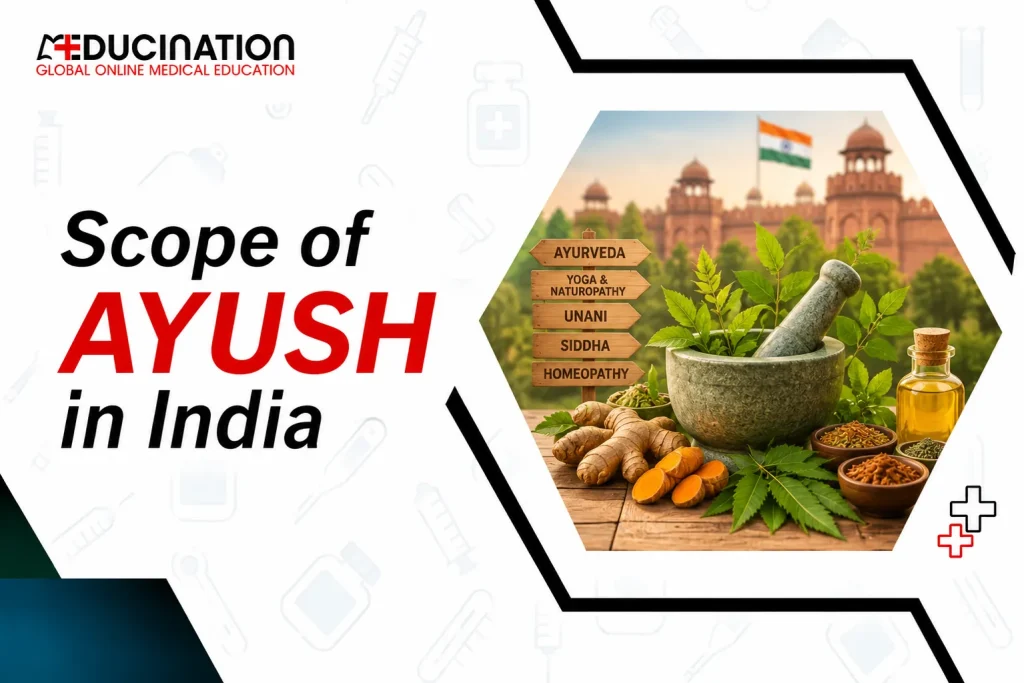
AYUSH, the umbrella covering Ayurveda, Yoga and Naturopathy, Unani, Siddha and Homoeopathy, now sits inside the national health system rather than beside it. There are more than seven lakh registered AYUSH practitioners in India, tens of thousands of AYUSH dispensaries, a dedicated central ministry and a place in the Ayushman Bharat Health and Wellness Centre network. The question is no longer whether the sector is legitimate. It is where inside the sector the good work sits.
Key takeaways
- AYUSH now sits inside the national health system rather than beside it, with a dedicated ministry, a place in the Health and Wellness Centre network and more than seven lakh registered practitioners.
- Government service is the most underrated part of the sector, offering stability that private practice usually takes a decade to match.
- Industry has become the largest employer of AYUSH graduates who leave clinical practice, particularly in formulation, quality control, regulatory affairs and medical affairs.
- The graduates who plateau are the ones who rely on the degree alone. Adding transferable clinical competence in diabetes, nutrition, mental health and geriatric care is what widens the career.
Clinical practice: the traditional route, with new limits and new openings
Independent practice remains the most common path. A BAMS or BHMS graduate can register with the relevant state board and set up a clinic.
The realistic picture is mixed. Practitioners in tier-two and tier-three towns, where AYUSH is culturally embedded and allopathic specialists are scarce, generally build patient volume faster than someone opening a clinic in a metro. Practitioners who develop a defined niche, such as pain and musculoskeletal management, dermatology, paediatric care or lifestyle disorder reversal, build faster than generalists.
The regulatory ground on cross-prescribing keeps shifting and varies between states. If your business plan depends on prescribing outside your system, get current legal advice for your specific state rather than relying on what a senior told you in college.
Government and public sector
This is the most underrated part of the sector.
Ayushman Bharat Health and Wellness Centres. A large number of these are staffed by AYUSH medical officers. Recruitment runs through state health missions and the National AYUSH Mission.
State AYUSH departments. Every state runs AYUSH dispensaries and hospitals with permanent medical officer posts, filled through state public service commissions.
Central services. ESIC, Railways, defence establishments, CGHS and central universities all employ AYUSH doctors.
Teaching. After a postgraduate degree, teaching posts in the roughly 900 AYUSH colleges across the country carry pay scales, security and research time.
Government roles rarely make anyone rich, but they offer stability that private practice takes a decade to match.
Postgraduate study
The AIAPGET is the common entrance for MD or MS in Ayurveda, Homoeopathy, Unani and Siddha. Specialisations include Panchakarma, Kayachikitsa, Shalya Tantra, Shalakya Tantra, Prasuti Tantra, Dravyaguna and Rasashastra, with equivalents in the other systems.
A PG degree changes the picture substantially. It opens teaching posts, senior hospital roles, credible super-speciality practice and research positions at CCRAS, CCRH and CCRUM.
Industry: where the money has moved
The Indian AYUSH industry has grown into a multi-billion-dollar sector, and industry now absorbs a large share of graduates who never intended to leave clinical practice.
- Ayurvedic and herbal pharmaceutical companies hire graduates for product development, formulation, quality control and regulatory affairs.
- Nutraceuticals and wellness FMCG need people who understand both classical texts and FSSAI labelling rules.
- Medical affairs and scientific marketing roles pay well and use clinical knowledge daily.
- Pharmacovigilance for AYUSH products is a growing regulatory requirement and a genuine skills gap.
Wellness, hospitality and medical tourism
Kerala built an international industry on Panchakarma. Rishikesh, Goa and Uttarakhand have followed. Resort chains, spas and dedicated wellness hospitals employ AYUSH graduates as consulting physicians, therapy supervisors and programme designers.
The work suits people who are comfortable with client-facing service delivery. It pays better than early private practice and often includes accommodation.
Research and integrative medicine
Integrative oncology, integrative palliative care and lifestyle disorder reversal programmes are the fastest-moving research areas. Several national cancer centres and state institutes now run formal integrative medicine units.
Research careers reward one thing above all: methodological literacy. An AYUSH graduate who understands trial design, statistics, systematic review methods and Good Clinical Practice is far more employable in this space than one who understands only the classical corpus.
The upskilling question
Here is the pattern that separates AYUSH graduates who plateau from those who do not.
The ones who plateau rely entirely on their degree. The ones who do not keep adding transferable clinical competencies on top of it, particularly in areas where patient need crosses systems: diabetes and metabolic disease, obesity and weight management, nutrition, mental health, geriatric and dementia care, palliative care and basic emergency response.
These are areas where an AYUSH practitioner is often the first and sometimes the only clinician a patient sees, especially in rural and semi-urban India. Being genuinely competent in recognition, risk stratification and referral is both good practice and good business.
Accredited short courses are the practical way to build that layer, and internationally accredited certification sits alongside a traditional qualification rather than competing with it. A fair number of the AYUSH practitioners studying with us work through the diabetes, nutrition and mental health modules for exactly this reason. How such certificates interact with Indian CME credit requirements varies by state council and is worth checking before you rely on them for renewal.
What AYUSH graduates actually earn
Figures vary enormously by state, setting and seniority, so treat these as broad ranges rather than promises.
- Fresh graduate in a private hospital or clinic: modest, often comparable to a junior MBBS resident stipend
- Government AYUSH medical officer: as per state pay scales, with allowances and pension benefits
- Established private practice after five to seven years: highly variable, driven almost entirely by niche and location
- Industry roles in medical affairs or regulatory: typically the strongest early-career salaries in the sector
- Wellness and medical tourism: strong, particularly with international clientele
Frequently asked questions
Is AYUSH a good career in 2026? Yes, provided you choose a defined path early. The sector has grown, but the graduates who do well are those who specialise, either clinically or into industry, research or government service.
Can an AYUSH doctor work abroad? Recognition varies. Some countries license Ayurveda and Homoeopathy practitioners, many do not. Wellness and yoga-linked roles travel far more easily than clinical licences.
Should I do a PG after BAMS or BHMS? If you want teaching, government seniority or credible specialist practice, yes. If you are heading into industry or wellness, targeted certifications and experience often matter more than a second degree.
What is the highest-paying AYUSH career? Typically industry roles in medical affairs, regulatory affairs and product development, followed by established niche private practice and international wellness.
This article is intended as general career information. Registration rules, prescribing rights and recruitment criteria differ between states and change over time. Confirm current requirements with your state AYUSH board or the relevant central council before acting on anything here.